
The Republican Party’s 2026 Electoral Defeat Through the Lens of SICOHERENCE™ — Structural Intelligence Coherence
A Source-Fidelity Research Evaluation of Political Representation, Government Decisions, and Public Outcomes
By Brian K. Burwell II | Founder & Chief Research Officer, Crown State of Mind LLC
November 10, 2026
I. Introducing SICOHERENCE™: The Research Foundation
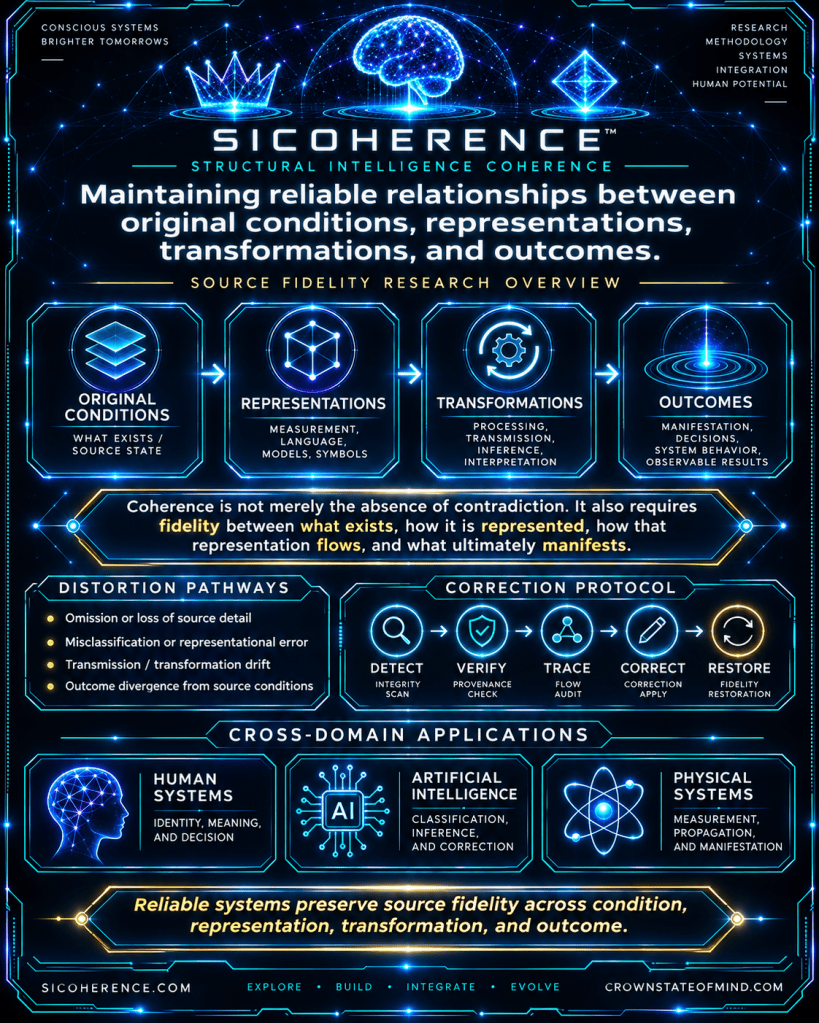
Understanding the relationship between political power, public representation, and government accountability requires examining more than political speeches, legislative accomplishments, or election results. It requires understanding how institutions receive information, interpret conditions, make decisions, and produce consequences.
This relationship is central to SICOHERENCE™ — Structural Intelligence Coherence — a research program developed by Brian K. Burwell II through Crown State of Mind LLC.
SICOHERENCE examines how coherence can be preserved across different systems, including human cognition, artificial intelligence, physical processes, technological infrastructures, and institutional decision-making.
Its governing principle is straightforward:
Coherence is not merely the absence of contradiction. It also requires fidelity between what exists, how it is represented, how that representation flows, and what ultimately manifests.
The research distinguishes between a system that operates consistently and a system that remains faithful to the original conditions it is supposed to represent.
These are not necessarily the same thing.
A system can consistently process incorrect information. An institution can follow established procedures while acting on incomplete assumptions. A decision-making process can operate according to its internal rules while producing consequences that diverge from its original purpose.
In each case, internal consistency may remain intact even when source fidelity has been compromised.
The SICOHERENCE research program investigates these relationships through a broader structural architecture intended to preserve identity, integrate knowledge, guide transformation, and restore alignment when systems drift from their source conditions.
The program extends across research, systems architecture, technological implementation, and cross-domain demonstrations. Its long-term scientific objectives include rigorous evaluation, reproducible measurement, and investigation of coherence relationships across different physical and informational substrates.
The present political investigation draws specifically from the November 2026 research manuscript:
Maintaining Reliable Relationships Between Original Conditions, Representations, Transformations, and Outcomes.
Published through Zenodo, this manuscript consolidates the source-fidelity principle into an operational framework for examining how information is represented, transmitted, transformed, and manifested.
Research publication: https://doi.org/10.5281/zenodo.24106769
The manuscript establishes a four-stage source-to-outcome relationship:
Original Conditions → Representations → Transformations → Outcomes
Each stage performs a distinct function, and each introduces opportunities for preserving or distorting information.
The original condition establishes the reference against which fidelity can be evaluated.
Representation converts that condition into language, measurements, models, categories, or symbolic descriptions.
Transformation carries those representations through processes, decisions, transmissions, or operational systems.
The outcome reveals what ultimately manifests as a result.
A faithful system preserves the relevant properties of its original conditions throughout the entire process.
A distorted system may lose, misclassify, omit, or improperly transform those properties before producing its final outcome.
The research manuscript identifies four principal distortion dimensions: representation error, transformation or transmission error, outcome deviation, and provenance loss.
These dimensions form the basis of a domain-specific distortion vector:
d = (drep, dtrans, dout, dprov)
The framework also establishes verification conditions for representation fidelity, transformation fidelity, provenance integrity, and outcome validity.
Together, these mechanisms provide an organized method for locating where an apparently coherent system may have departed from its original reference conditions.
The Sefirotic Interpretation
Within SICOHERENCE, the relationship between representation, transformation, and manifestation is also examined through the functional correspondence of Hod, Yesod, and Malkuth.
Hod concerns representation: the categorization, description, interpretation, and labeling of information.
Yesod concerns transformation and transmission: the integration and movement of representations through systems.
Malkuth concerns manifestation: the observable decisions, actions, and consequences produced by those processes.
These relationships provide a structured way to examine how an initial error may travel through an otherwise functioning system and eventually become consequential.
The manuscript illustrates this principle using the 1999 Mars Climate Orbiter failure, in which incompatible measurement units contributed to a navigation error and the loss of the spacecraft.
The calculations did not need to be internally contradictory for the final outcome to be incorrect. The relevant information had been represented and transmitted under incompatible conventions.
The error propagated through the system.
That distinction is fundamental to the present investigation.
SICOHERENCE also provides a correction methodology emphasizing detection, verification, provenance tracing, authorized correction, independent retesting, and restoration.
Instead of addressing only the final consequence of a failure, the methodology seeks to identify the earliest supported point at which source fidelity was lost.
This principle has substantial implications for the study of government.
Political institutions are information-processing and decision-making systems. They receive public concerns, interpret national conditions, establish priorities, formulate legislation, allocate resources, implement programs, and produce outcomes that affect millions of people.
Their effectiveness cannot be understood solely through the internal consistency of their political positions.
It must also be examined through the relationship between the conditions they were established to address and the consequences of their decisions.
This is where SICOHERENCE becomes directly relevant to political representation.
II. Applying SICOHERENCE to Political Institutions
The application of SICOHERENCE to government begins by identifying the original source conditions.
In a democratic republic, those conditions include the circumstances of the population, constitutional obligations, legitimate institutional purposes, public needs, and the issues citizens identify as important.
Government is responsible for interpreting those conditions and developing responses through authorized political processes.
Political parties play an important role in that process. They organize competing priorities, develop policy positions, and present governing alternatives to voters.
However, the priorities of a political party are not identical to the conditions of the entire population.
A party represents a political constituency.
A government exercises authority over the nation.
This distinction establishes a central structural relationship.
An elected official may remain consistent with a political movement while making decisions that affect citizens outside that movement.
The interests of those citizens remain part of the governing institution’s source conditions, even when they disagree with the party holding power.
Under SICOHERENCE, political representation can therefore be examined through the following relationships.
Original Conditions: What Americans are experiencing and what the governing institution is responsible for addressing.
Representation — Hod: How elected officials describe those circumstances through political messaging, campaign promises, ideological classifications, and stated policy objectives.
Transformation — Yesod: How political representations become legislation, federal budgets, executive orders, administrative procedures, and enforcement decisions.
Outcome — Malkuth: What those actions produce in the lives of Americans, including economic consequences, public services, legal effects, institutional performance, and electoral responses.
The structural question is whether relevant source conditions remain adequately represented throughout the governing process.
This does not require universal agreement on policy.
Americans may share a concern about healthcare costs while disagreeing about how healthcare should be financed.
They may share an interest in public safety while disagreeing about enforcement priorities.
They may agree that retirement security matters while disagreeing about federal taxation and long-term program financing.
Source fidelity requires recognizing those conditions accurately, preserving relevant information about them, and evaluating the consequences of the decisions made in response.
It does not require treating every political preference as an equally appropriate solution.
The distinction allows SICOHERENCE to evaluate government without reducing the analysis to partisan loyalty.
The same method can be applied to Republican, Democratic, independent, or nonpartisan institutions.
For this investigation, the Republican Party’s 2025–2026 governing record and its subsequent electoral defeat provide the case under examination.
III. The 2026 Elections: An Observable Political Outcome
The Republican Party entered the November 3, 2026, midterm elections controlling the presidency and both chambers of Congress.
By November 4, the Associated Press had called Democratic control of both the House of Representatives and the Senate. The Associated Press
The election produced a significant change in congressional authority.
But within SICOHERENCE, the electoral result is not the beginning of the source-to-outcome chain.
It is a manifestation that can be examined in relation to the conditions and institutional decisions preceding it.
The fundamental research question is:
Did the Republican Party maintain fidelity between the priorities of the broader American public, the political representations it advanced, the governing decisions it implemented, and the outcomes citizens experienced?
To examine that relationship, the analysis must first establish what voters were communicating before the election.
The relevant evidence is available.
IV. The American People Made Their Priorities Clear
An October 8–12, 2026, survey conducted by the AP-NORC Center for Public Affairs Research documented the issues voters considered most important when deciding how to vote.
The results were substantial.
The economy was identified by 85% of voters.
The cost of living followed at 84%.
Healthcare was identified by 69%, while 64% identified the war with Iran.
Immigration and crime were each identified by 45%.
The survey also found that approximately eight in ten voters wanted substantial change or a complete overhaul in how the country was governed.
Meanwhile, 79% disapproved of President Donald Trump’s handling of the cost of living, and 74% disapproved of his handling of the economy. AP-NORC
These findings establish the original public conditions against which political priorities can be examined.
Americans were expressing concern about economic security, everyday affordability, medical care, international conflict, and government performance.
The public was not communicating a single ideological position.
Republicans, Democrats, and independents differed in their policy preferences and in the emphasis they placed on particular issues.
However, concerns about material conditions extended across political affiliations.
A separate Gallup survey conducted October 1–19 found that the economy, healthcare, and Iran were among the leading issues for independent voters.
Among independents, 51% considered the economy extremely important, 48% said the same about healthcare, and 46% about Iran.
Republican respondents placed their greatest emphasis on immigration and crime, while Democratic respondents prioritized healthcare, economic distribution, and the economy. Gallup.com
The distinction is significant.
The Republican base had identifiable priorities. So did voters outside the party.
The responsibilities of national government encompassed both.
This creates a measurable challenge for political representation: determining whether governing priorities adequately recognized the range of conditions facing the population.
The public’s concerns were documented before the election.
Consequently, the investigation does not need to rely exclusively on retrospective explanations of voter dissatisfaction.
It can compare those documented priorities with actual governing decisions.
V. Medicaid: Evaluating the Relationship Between Fiscal Policy and Healthcare Needs
On July 4, 2025, President Trump signed Public Law 119-21, commonly known as the One Big Beautiful Bill Act.
The legislation significantly altered federal Medicaid policy.
Among its provisions were new community engagement requirements, additional eligibility verification procedures, changes to Medicaid financing, and restrictions affecting certain payments to healthcare providers.
In June 2026, the Centers for Medicare & Medicaid Services issued an implementing rule requiring certain adults to demonstrate 80 hours per month of qualifying work, education, community service, or related activity.
The requirements include statutory exemptions and implementation safeguards. States generally must implement them by January 1, 2027. CMS
The administration presented these reforms in terms of program integrity, employment, fiscal responsibility, and the long-term sustainability of Medicaid.
Those objectives constitute the political and administrative representation of the policy.
The transformation can be examined through the legislation’s actual requirements and financing mechanisms.
According to the Congressional Research Service, the Congressional Budget Office estimated that the Medicaid provisions would reduce federal outlays by approximately $989.7 billion between fiscal years 2025 and 2034.
CBO also projected that the provisions would increase the number of uninsured Americans by approximately 7.5 million in 2034 relative to its previous-law baseline. Every CRS Report +1
The distinction between these outcomes matters.
Reducing federal spending is a fiscal objective.
Maintaining access to healthcare is a separate public condition.
A government can pursue fiscal savings while also needing to account for coverage continuity, access to medical services, administrative burdens, and the consequences for eligible beneficiaries.
The legislation additionally established a $50 billion Rural Health Transformation Program intended to support healthcare delivery and infrastructure in rural communities.
That program represents a distinct investment and must be evaluated alongside the law’s other effects.
SICOHERENCE Research Evaluation: Medicaid
The original conditions include healthcare affordability, insurance coverage, medical access, and the financial vulnerability of households.
The representation emphasizes fiscal sustainability, eligibility integrity, and work participation.
The transformation introduces statutory eligibility requirements, financing restrictions, administrative verification, and rural-health investments.
The outcomes include projected federal savings, projected changes in insurance coverage, and measurable implementation consequences as the provisions take effect.
The central structural issue is whether the governing process preserves both the fiscal objectives and the healthcare conditions relevant to the program’s purpose.
If administrative requirements result in otherwise eligible individuals losing coverage because of verification failures, the resulting discrepancy can be traced to a transformation-stage problem.
If fiscal reforms improve program administration while maintaining appropriate access, those benefits also belong in the evaluation.
The significant finding is that fiscal performance and healthcare performance require separate measurements.
A reduction in government expenditure does not independently establish an improvement in public healthcare outcomes.
That is the source-fidelity distinction this legislative case makes visible.
VI. Social Security: The Difference Between Political Representation and Actual Benefits
Social Security presents another important example of the distinction between political promises, enacted policy, and observable institutional performance.
Americans depend on Social Security for retirement income, disability benefits, survivor protection, and financial stability.
Public concerns about the program involve several distinct conditions: current monthly benefits, taxation, administrative services, and long-term financing.
These conditions are related but should not be treated as interchangeable.
The 2025 reconciliation legislation introduced an additional federal income-tax deduction of up to $6,000 for qualifying individuals age 65 or older.
The deduction is available from 2025 through 2028, with income-based phaseouts.
It provides a tax benefit to qualifying older Americans.
However, it did not eliminate the existing federal rules governing the taxation of Social Security benefits. Internal Revenue Service
That distinction establishes a direct representation-fidelity test.
Describing the legislation as additional tax relief for qualifying seniors communicates the policy’s general legal mechanism.
Describing it as the complete elimination of federal taxation on Social Security benefits would communicate a broader change than the law establishes.
The representation affects what citizens understand about their actual financial circumstances.
Social Security administration provides a separate transformation for evaluation.
The administration pursued workforce restructuring, changes to workplace policies, and expanded digital services.
A January 2026 Government Accountability Office report examined workforce-management challenges and recommended improvements to the agency’s human-capital planning.
GAO subsequently reported that the Social Security Administration updated its staffing plan to address important skills gaps, while questions concerning its telework program remained. U.S. GAO
At the same time, the Social Security Administration reported improvements in service performance.
In October 2026, the agency stated that average national telephone answer times had declined from 28 minutes in fiscal year 2024 to 5.6 minutes in fiscal year 2026.
It also reported improvements in field-office wait times, online transactions, and disability-claim processing. SSA
These results are relevant because they demonstrate that different components of the same governing system may produce different outcomes.
The financing issue introduces another dimension.
The 2026 Social Security Trustees Report projected that the Old-Age and Survivors Insurance Trust Fund would exhaust its reserves in the fourth quarter of 2032.
Without legislative changes, continuing income would cover approximately 78% of scheduled retirement and survivor benefits at that point.
The financing challenge predates the current administration, but remains a major institutional responsibility. SSA
SICOHERENCE Research Evaluation: Social Security
The original conditions include retirement security, accurate tax information, dependable service delivery, and sustainable financing.
The representation includes commitments to protecting benefits, providing tax relief, and improving administrative efficiency.
The transformation includes tax legislation, administrative restructuring, service modernization, and ongoing financing policy.
The outcomes include tax benefits for qualifying seniors, reported improvements in several service measures, workforce-management challenges, and long-term financing pressures.
The evidence reveals why a source-fidelity analysis requires precision.
Political claims about protecting Social Security must identify what is actually being protected or changed.
A tax deduction is not the same as eliminating taxation on benefits.
Administrative improvements are not the same as resolving long-term financing.
A projected future funding shortfall is not the same as an enacted reduction in current benefits.
Faithful political representation requires preserving these distinctions rather than combining them into one convenient political narrative.
VII. ICE Enforcement: Examining Institutional Expansion, Representation, and Accountability
Immigration enforcement was a central governing priority of the Trump administration.
The administration emphasized stronger immigration enforcement, border security, expanded detention capacity, and the removal of individuals subject to deportation.
Congress supported these priorities through substantial additional funding and legislative action.
The 2025 reconciliation law provided approximately $75 billion in additional funding for Immigration and Customs Enforcement through fiscal year 2029, including $45 billion for detention capacity.
The subsequent institutional expansion was substantial.
According to the Government Accountability Office, ICE added more than 40 detention facilities holding people for longer than 72 hours between April 2025 and April 2026.
During that period, the average daily detained population in those facilities grew by more than 50%, reaching 61,817 individuals.
Those figures demonstrate increased operational capacity.
However, the expansion also introduced documented administrative concerns.
In September 2026, GAO reported that ICE had purchased 11 warehouses at an estimated cost of approximately $1.07 billion for detention expansion.
The agency subsequently planned to sell seven of them.
GAO identified more than $20 million in nonrecoverable expenses associated with the facilities slated for sale.
The investigation also found that ICE had pursued detention-expansion initiatives without sufficient comprehensive strategic planning. U.S. GAO
A separate GAO report released November 5, 2026, examined changes in detention oversight.
The report found that inspection procedures had changed while detention populations increased.
In some circumstances, inspections became less frequent, and the agency relied more heavily on facility self-inspections.
GAO determined that ICE had not adequately evaluated how those changes affected its ability to identify deficiencies and maintain compliance with detention standards. U.S. GAO
These findings establish specific institutional relationships between expansion, resource allocation, planning, and oversight.
Another representational question concerns the population affected by enforcement.
Research published by the Deportation Data Project in September 2026 found that approximately 27% of interior ICE arrests leading to detention bookings in July involved individuals with criminal convictions.
The absence of a criminal conviction does not necessarily mean an individual is exempt from civil immigration enforcement.
Nevertheless, the finding provides an observable basis for comparing political claims about enforcement priorities with the characteristics of those actually arrested. Deportation Data Project
SICOHERENCE Research Evaluation: ICE
The original conditions include immigration-law enforcement, public safety, lawful administrative procedures, detention standards, and responsible federal spending.
The representation emphasizes stronger enforcement, border security, criminal threats, and operational effectiveness.
The transformation includes additional appropriations, expanded enforcement operations, detention procurement, and changes to oversight systems.
The outcomes include increased detention capacity, changing arrest patterns, documented procurement waste, and concerns about compliance oversight.
The research identifies two distinct relationships.
The first concerns whether the population affected by enforcement corresponds to the priorities described in political representations.
The second concerns whether the expansion of enforcement operations preserved the planning and oversight requirements necessary for institutional integrity.
Both relationships can be examined through records rather than political slogans.
An increase in enforcement activity establishes an increase in activity. It does not independently establish that the activity is efficient, appropriately targeted, or consistent with every applicable institutional requirement.
The GAO findings provide documented examples of transformation-stage problems that can be traced to identifiable administrative decisions.
This is precisely the type of institutional process that the SICOHERENCE source-fidelity framework is designed to examine.
VIII. The War With Iran: Tracing National Security Decisions to Domestic Conditions
On February 28, 2026, the United States and Israel initiated military operations against Iran.
The administration identified objectives including preventing Iran from obtaining nuclear weapons, reducing its missile capabilities, and addressing threats associated with the Iranian government.
The conflict expanded into a regional confrontation involving retaliatory attacks, interruptions to commercial shipping, and significant economic effects.
According to a September 2026 Congressional Research Service report, an April ceasefire and subsequent June agreement did not produce a lasting settlement.
Limited military exchanges continued alongside diplomatic efforts and renewed sanctions pressure. Every CRS Report
The fiscal consequences were substantial.
In September 2026, the Congressional Budget Office estimated that the conflict had cost the Department of Defense approximately $38 billion through August 1.
That estimate covered operational, logistical, and sustainment costs associated with the military campaign.
CBO also examined broader economic effects resulting from disruptions to energy markets and commercial activity. Congressional Budget Office
These findings are relevant to the original conditions documented in voter polling.
Americans identified the economy and cost of living as their leading election concerns.
They also identified the war with Iran as a major issue.
Military decisions, energy prices, and household economic conditions were therefore connected through observable processes.
The October AP-NORC survey found that 64% of voters considered the war with Iran one of the most important issues influencing their electoral choices.
Following the election, a Reuters/Ipsos survey completed November 9 found that 71% of American adults supported congressional legislation to end the war.
That included 51% of Republican respondents and 93% of Democratic respondents.
The same survey found strong demand for congressional attention to affordability. Reuters
This evidence is particularly important because it identifies public concerns extending across party boundaries.
The war was not only an issue for Democratic voters.
Significant numbers of Republicans also expressed support for ending the conflict.
SICOHERENCE Research Evaluation: Iran
The original conditions include national security concerns, economic stability, public expectations, and the strategic conditions affecting American interests.
The representation includes the administration’s stated military objectives and descriptions of the threats associated with Iran.
The transformation includes military operations, expenditures, deployments, diplomatic negotiations, and sanctions.
The outcomes include documented military costs, energy-market disruption, ongoing strategic consequences, and public responses to the conflict.
The source-fidelity evaluation examines how the original security objectives relate to the decisions undertaken and the resulting consequences.
It also examines how foreign-policy transformations affect domestic conditions that citizens identify as important.
This relationship cannot be understood through military objectives alone.
It requires examining economic consequences, strategic results, public costs, and the conditions created by continued conflict.
National security decisions can produce outcomes far beyond the immediate military operation, including consequences experienced directly by American households.
That relationship is central to evaluating whether a governing system has adequately preserved the broader conditions relevant to its responsibilities.
IX. Political Labels and the Problem of Representational Distortion
Political discourse frequently relies on classifications.
Terms such as socialist, radical, extremist, and other ideological or security-related labels are used to characterize individuals, movements, and policy positions.
Such classifications may communicate meaningful distinctions when used accurately.
However, they also create opportunities for representational distortion when applied without sufficient evidence or when they replace the actual conditions being discussed.
A citizen concerned about healthcare affordability cannot be adequately understood through an ideological label alone.
A worker concerned about wages or household expenses is expressing an economic condition that requires examination.
An American questioning the costs or objectives of military intervention is not necessarily rejecting national security.
And disagreement with a governing administration does not automatically indicate opposition to the country.
The SICOHERENCE research identifies misclassification, omission of relevant source information, and unsupported inference as possible pathways through which representational errors enter decision-making systems.
These mechanisms have direct political applications.
Consider a public concern about healthcare costs.
The original condition may involve an individual’s inability to afford treatment.
The political representation may instead classify the concern primarily as an ideological dispute.
The transformation may then prioritize responding to the ideological classification rather than addressing the underlying affordability problem.
The eventual outcome may leave the original condition substantially unchanged.
This illustrates how an error introduced during representation can influence the entire decision-making chain.
The relevant SICOHERENCE question is:
Did the institution respond to the condition that actually existed, or to a political representation that failed to preserve its relevant properties?
The same question can be applied to immigration, economic policy, Social Security, and foreign affairs.
This does not eliminate the role of political ideology.
It establishes the need to distinguish ideological descriptions from the original circumstances they claim to explain.
The Changing Information Environment
The widespread availability of smartphones, digital archives, online legislation, government reports, recorded speeches, and independent research has expanded opportunities for public verification.
Citizens can compare campaign promises with enacted legislation.
They can examine federal spending records, policy changes, and government oversight findings.
They can review statements alongside the circumstances in which those statements were made.
The same digital environment can also spread misinformation, incomplete context, and misleading representations.
Consequently, access to information and source fidelity remain distinct.
The relevant development is that citizens have more opportunities to examine the relationship between political narratives and observable decisions.
For political institutions, this creates an accountability environment in which messaging can increasingly be compared with documentary evidence.
Political representations must remain answerable to the conditions and records they claim to describe.
X. Coalition Loyalty and the Responsibility to Govern an Entire Nation
The distinction between political power and public representation becomes especially important when examining the relationship between a political movement and a governing institution.
MAGA represents a significant constituency within the Republican coalition.
Republican voters have legitimate political priorities, just as Democratic voters, independents, and unaffiliated citizens do.
A political party may organize around the preferences and objectives of its members.
A national government, however, exercises authority over people who do not necessarily share those preferences.
This creates a structural distinction between coalition loyalty and institutional responsibility.
A political coalition seeks to advance a defined agenda.
A governing institution must administer public responsibilities across an entire population.
Those functions overlap, but they are not identical.
A president is elected through a political process, yet presidential decisions affect Americans regardless of their party affiliation.
Congress is composed of partisan representatives, yet federal legislation establishes obligations and consequences extending beyond the voters who supported the majority.
Government programs serve individuals whose political beliefs may differ substantially from those of the officials administering them.
The same institutional responsibility applies to public safety, healthcare, retirement benefits, taxation, and national security.
This does not require every governing decision to satisfy every political constituency.
Public policy inevitably involves competing interests, limited resources, and disagreement.
It does require an accurate understanding of the population affected and meaningful accountability for the consequences of institutional decisions.
Under SICOHERENCE, the question is not whether an administration remained loyal to its political movement.
It is whether that loyalty preserved or displaced relevant information about the broader conditions it was responsible for addressing.
That distinction is central to the investigation of the 2026 Republican defeat.
XI. What the 2026 Election Reveals About Political Representation
The Associated Press’s post-election voter analysis provides further evidence of the relationship between public dissatisfaction and governing outcomes.
Approximately two-thirds of voters said Trump’s policies had made the economy worse.
A similar share believed the president did not have the right priorities.
About seven in ten said Congress was not doing enough to provide checks and balances on presidential power.
The AP also found that voters experiencing financial hardship strongly favored Democratic candidates in numerous congressional contests. The Associated Press
These findings connect the election outcome to the original conditions documented before Election Day.
Economic security was a leading public concern.
Healthcare, international conflict, and government accountability were significant concerns.
The governing record included major changes affecting healthcare, federal enforcement, retirement taxation, and military commitments.
The election then produced a substantial shift in congressional control amid widespread dissatisfaction with the administration’s priorities.
The relationship warrants direct evaluation.
However, the public’s dissatisfaction did not translate into unconditional confidence in the Democratic Party.
The AP Voter Poll found that many voters remained skeptical of both major parties.
On several issues, substantial portions of the electorate believed neither party was better positioned to address their concerns.
This finding reinforces the broader institutional question.
The electorate was not simply expressing enthusiasm for one political identity over another.
Many citizens were communicating dissatisfaction with the performance and responsiveness of governing institutions.
The distinction is consequential for SICOHERENCE.
Political identity is a representation.
Public conditions are the source reference.
Government decisions are transformations.
Electoral outcomes provide feedback about how citizens evaluated their experiences, priorities, and available political alternatives.
The four stages can now be examined together.
The original conditions included substantial concern about affordability, healthcare, international conflict, and accountability.
The political representations involved competing claims about economic improvement, fiscal responsibility, enforcement effectiveness, retirement security, and national security.
The transformations included major legislation, administrative changes, expanded enforcement activity, and military operations.
The manifested outcomes included projected coverage changes, measurable administrative effects, documented expenditures, public dissatisfaction, and the Republican Party’s electoral losses.
These relationships provide a substantive political case for the SICOHERENCE research program.
XII. Source Correction Versus Political Rebranding
One of the most consequential distinctions in the SICOHERENCE manuscript concerns the difference between correcting a visible result and correcting the source of the problem that produced it.
An outcome may reveal a failure that originated much earlier in the decision-making chain.
Changing the final result alone may leave the underlying source of distortion intact.
This principle has direct relevance to political institutions responding to electoral defeat.
A party can change campaign slogans, replace candidates, adjust its communication strategy, reorganize leadership, or introduce new political messaging.
Those changes may alter its public presentation.
But a change in presentation does not necessarily change the relationship between governing decisions and the conditions citizens experience.
If the original problem involves inaccurate representations of public priorities, the correction must address how those priorities are understood.
If the problem involves policy implementation, correction must address the institutional process producing the unwanted consequence.
If the problem involves inadequate administrative oversight, correction must address the procedures and accountability mechanisms responsible for maintaining integrity.
SICOHERENCE provides a correction sequence built around detecting the discrepancy, verifying the source, tracing the transformation, correcting the supported point of distortion, and evaluating whether fidelity has been restored.
Applied to political systems, this methodology distinguishes institutional improvement from changes in political presentation.
The question becomes whether a response to electoral dissatisfaction changes the conditions generating that dissatisfaction or merely changes how those conditions are described.
This distinction applies equally to any political party.
A government cannot demonstrate that a public problem has been resolved solely through changes in rhetoric.
The relevant outcome must be examined.
XIII. Research Findings: Applying the Source-Fidelity Evaluation
The combined evidence produces several findings within the political application of SICOHERENCE.
First, the original public conditions were documented before the election.
The 2026 polling record identified economic security, affordability, healthcare, international conflict, and government performance as significant concerns.
These conditions provide observable reference points against which governing priorities can be examined.
Second, political representations and institutional transformations must be evaluated separately.
The governing record demonstrates that broad political descriptions do not always communicate the full legal or operational characteristics of enacted policy.
The Social Security senior deduction provides a clear example of why accurate representation of statutory conditions matters.
Third, institutional activity and institutional effectiveness are different measurements.
The expansion of ICE detention capacity increased operational activity.
Government oversight simultaneously identified planning deficiencies, unrecoverable expenditures, and unanswered questions about inspection effectiveness.
The expansion and the deficiencies are both measurable features of the institutional record.
Fourth, policy objectives and public consequences can diverge across different dimensions.
Medicaid legislation establishes a relationship between intended federal savings and projected changes in insurance coverage.
The Iran conflict establishes relationships between military objectives, federal expenditures, energy-market disruption, and domestic economic concerns.
These cases demonstrate why one intended outcome cannot automatically represent the entire consequence of a governing decision.
Fifth, different components of the same institution may demonstrate different levels of fidelity.
Social Security administration provides an example through reported service improvements, statutory tax changes, workforce-management findings, and unresolved financing conditions.
The evidence should be evaluated across each relevant function rather than compressed into one political conclusion.
Sixth, the electoral outcome provides observable feedback concerning public perceptions of governing priorities.
The AP Voter Poll documented widespread dissatisfaction with the administration’s economic policies, priorities, and congressional oversight.
These findings connect public perceptions to the electoral result and provide a basis for examining the preceding institutional record.
Together, these observations demonstrate the practical utility of tracing political processes through original conditions, representations, transformations, and outcomes.
The research is not limited to identifying contradictions in political statements.
It examines where relevant information is preserved, where measurable discrepancies emerge, and how institutional decisions translate into consequences.
XIV. The Broader Question of Political Coherence
The Republican Party’s 2026 defeat raises a question extending beyond the Republican Party itself.
What establishes coherence in a governing institution?
Is it consistency with a political platform?
Loyalty to an elected leader?
Success in passing legislation?
The ability to mobilize supporters?
Or the capacity to maintain reliable relationships between public conditions, institutional responsibilities, governing decisions, and observable outcomes?
SICOHERENCE introduces a way to examine these dimensions without treating them as interchangeable.
A political organization may operate effectively according to its internal objectives while still facing measurable problems in the relationship between those objectives and the conditions of the population affected by its decisions.
The governing process must therefore be examined as a complete chain.
The quality of political representation cannot be determined solely by whether officials remained loyal to their party.
Nor can institutional effectiveness be determined solely by the volume of legislation passed, the amount of money spent, or the number of administrative actions taken.
Those measurements describe activity.
The source-to-outcome relationship determines how that activity corresponds to the conditions it was intended to address.
Political accountability depends on making that relationship visible.
For a government representing a diverse population, this includes recognizing that the interests of the nation extend beyond the membership of any political movement.
The American public includes Republicans, Democrats, independents, unaffiliated citizens, and people who do not participate in elections.
All remain subject to federal authority.
All remain affected by government decisions.
And all form part of the population whose conditions must be considered when evaluating national governance.
That responsibility continues regardless of which political party controls Congress or the presidency.
Conclusion: Political Power Is Not the Same as Public Representation
The Republican Party’s losses in the 2026 midterm elections provide a significant case for examining the relationship between political priorities, governing decisions, and public outcomes.
The original conditions were documented through voter concerns about economic stability, affordability, healthcare, international conflict, and government accountability.
The governing record reveals major institutional transformations involving Medicaid, Social Security, immigration enforcement, and the war with Iran.
The resulting evidence includes projected changes in healthcare coverage, measurable administrative performance, documented oversight deficiencies, substantial military expenditures, and public dissatisfaction reflected in the election.
SICOHERENCE brings these relationships into a unified analytical structure.
Its central distinction is that a system’s internal consistency does not independently establish fidelity to the conditions it is supposed to represent.
In political institutions, the distinction separates loyalty to a movement from responsibility to the broader public.
An elected government may maintain a consistent political identity while making decisions whose consequences extend far beyond the constituency that elected it.
Those consequences remain part of the governing record.
The central responsibility of political representation is not simply to maintain an ideology, repeat promises, or exercise authority.
It is to maintain an accountable relationship between the conditions of the people, the representations made about those conditions, the decisions taken through public institutions, and the outcomes those decisions produce.
The 2026 election provides a contemporary opportunity to examine that relationship.
The SICOHERENCE research program provides the method.
And the evidence establishes why political institutions must be evaluated through more than the consistency of their internal narratives.
Political power is not the same as public representation.
A governing institution’s coherence is measured through the fidelity of the relationship between public conditions, institutional decisions, and manifested outcomes.
Political authority determines who can make decisions.
Structural coherence examines whether those decisions remain faithfully connected to the conditions they are intended to address.
That distinction is fundamental to understanding institutional accountability in contemporary American politics.
Research Foundation and Supporting Sources
Foundational SICOHERENCE™ Research
Burwell II, Brian K. (2026). Maintaining Reliable Relationships Between Original Conditions, Representations, Transformations, and Outcomes. Crown State of Mind LLC. https://doi.org/10.5281/zenodo.24106769
Burwell II, Brian K. (2026). A Source-Fidelity Mathematical Framework for Coherence Preservation, Distortion Correction, and Critical-Line Invariance. https://doi.org/10.5281/zenodo.20839581
Burwell II, Brian K. (2026). A Coherence-Based Correction Model for AI Generation Systems Using Diamond Lattice and Sefirotic Structures. https://doi.org/10.5281/zenodo.19563325
Election Results and Public Opinion
AP-NORC Center for Public Affairs Research. October 15, 2026. Ahead of the Midterms, Most Voters Cite the Economy and Cost of Living as Top Issues and Favor Political Change.
Associated Press. November 4, 2026. How Trump and Republicans Lost the 2026 Midterm Elections, According to the AP Voter Poll.
Gallup. October 29, 2026. The Issues Voters Say Matter Most This Midterm.
https://news.gallup.com/poll/716333/issue-voters-say-matter-midterm.aspx
Reuters/Ipsos. November 10, 2026. Most Americans Want New Democratic Congress to End Trump’s Iran War.
Government Policy and Institutional Evidence
Congressional Research Service. Health Provisions in P.L. 119-21, the FY2025 Reconciliation Law. Report R48633.
https://www.everycrsreport.com/reports/R48633.html
Congressional Budget Office. The Budget and Economic Outlook: 2026 to 2036.
https://www.cbo.gov/publication/62105
Centers for Medicare & Medicaid Services. June 1, 2026. Medicaid Community Engagement Requirement for Certain Individuals.
Internal Revenue Service. Working Families Tax Cuts — Individuals and Workers.
https://www.irs.gov/newsroom/working-families-tax-cuts-individuals-and-workers
Social Security Administration. 2026 Social Security Trustees Report.
https://www.ssa.gov/oact/trsum/
Government Accountability Office. January 23, 2026. Federal Telework: Social Security Administration Needs a Plan to Maintain a Workforce with the Skills Needed to Provide Timely Service. GAO-26-107645.
https://www.gao.gov/products/gao-26-107645
Government Accountability Office. September 24, 2026. Immigration Detention: Urgent Planning Needed to Avoid Further Waste of Taxpayer Dollars. GAO-26-108663.
https://www.gao.gov/products/gao-26-108663
Government Accountability Office. November 5, 2026. Immigration Detention: Changes in Inspections of ICE Facilities Raise Questions About Oversight. GAO-27-109299.
https://www.gao.gov/products/gao-27-109299
Deportation Data Project. September 8, 2026. Understanding the Summer 2026 Surge in ICE Arrests.
https://deportationdata.org/analysis/immigration-arrests-in-2026.html
Congressional Research Service. September 18, 2026. U.S. Conflict with Iran. Report R48887.
https://www.everycrsreport.com/reports/R48887.html
Congressional Budget Office. September 15, 2026. Estimating the Cost of Combat Operations Against Iran.
https://www.cbo.gov/publication/62756
ROYAL POLITICS | CROWN STATE OF MIND LLC
SICOHERENCE™ — Structural Intelligence Coherence
One Intelligence. Multiple Realities.
Research • Systems • Technology • People • Culture


Leave a Reply