
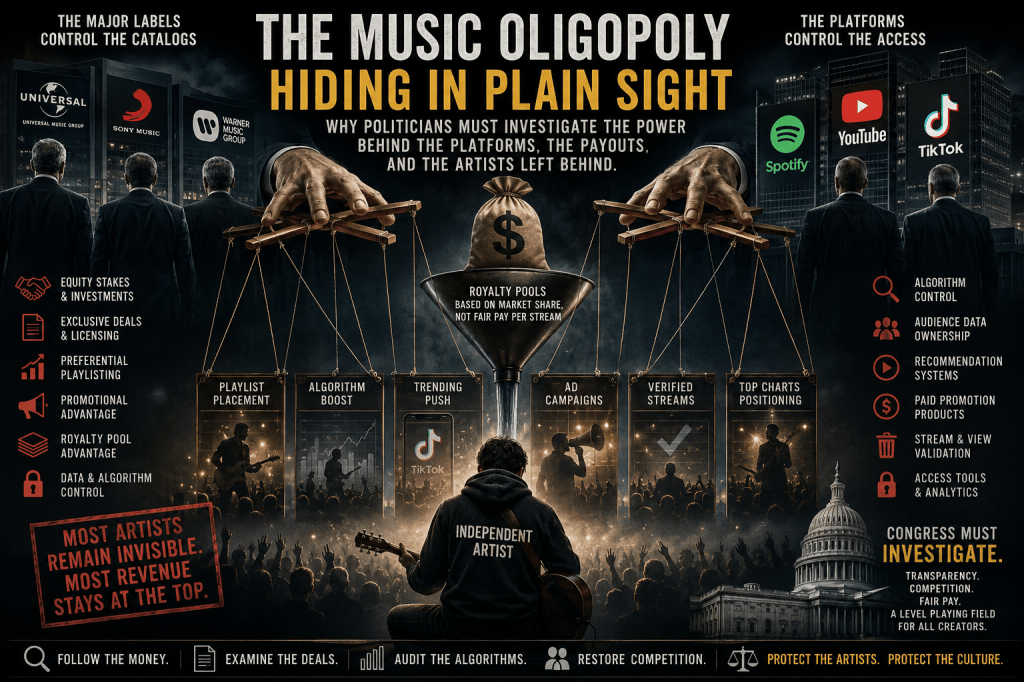
Why Congress Must Investigate the Financial, Contractual, and Algorithmic Relationships Between Major Record Labels and Digital Platforms
By Royal Politics
Politicians frequently speak about supporting small businesses, protecting American creators, regulating Big Tech, and preventing monopolistic conduct. Yet one of the most concentrated and culturally influential markets in the country receives surprisingly little sustained political scrutiny: the digital music industry.
Independent musicians are told that the internet democratized music.
They are told that Spotify, YouTube, TikTok, Instagram, and other platforms eliminated the old gatekeepers. Artists supposedly no longer need major record labels, radio programmers, television networks, physical distributors, or retail chains. Anyone can upload a song, reach a global audience, and allow listeners to decide whether the music succeeds.
That is the public story.
The underlying structure is far more complicated.
A small number of major record companies control much of the commercially essential music catalog. A small number of technology companies control the platforms where music is discovered, promoted, measured, streamed, monetized, and shared. Those labels and platforms are connected through licensing agreements, historical equity stakes, joint ventures, promotional partnerships, data relationships, royalty systems, and private negotiations unavailable to ordinary artists.
The public sees separate companies.
Politicians need to investigate the system connecting them.
The correct legal description may not be one traditional monopoly controlled by a single corporation. The structure more closely resembles a vertically entangled oligopoly: a concentrated group of major rightsholders negotiating with a concentrated group of dominant technology platforms, while independent artists remain dependent on both.
The danger is not merely that these companies are large.
The danger is that they may possess the collective power to determine who receives access to the modern music marketplace, how that access is measured, and how the resulting money is distributed.
The Digital Music Industry Did Not Eliminate Gatekeepers
Streaming changed the form of gatekeeping.
Under the older system, major labels controlled recording budgets, manufacturing, physical distribution, radio promotion, retail placement, music television, press relationships, and access to established industry networks.
Digital platforms reduced the cost of uploading a song, but uploading is not the same as receiving distribution.
The modern gatekeeper controls:
- recommendation algorithms;
- search placement;
- editorial playlists;
- autoplay;
- homepage exposure;
- short-form trends;
- official artist channels;
- audience targeting;
- advertising inventory;
- stream and view validation;
- follower and subscriber counts;
- royalty eligibility;
- artist analytics;
- access to listener data.
An independent artist can technically place music on a platform while remaining practically invisible within it.
That distinction is essential.
The economic product offered by a streaming or social platform is not merely storage space. It is access to attention. When the platform controls whether a song is recommended, inserted into a playlist, placed before an audience, or allowed to develop momentum, the platform is allocating economic opportunity.
The gate is no longer a record-store shelf.
The gate is an algorithm.
Three Record Companies Still Control Most of the Market
The recorded-music industry remains extraordinarily concentrated.
Warner Music Group reported that Universal Music Group held approximately 32 percent of global recorded-music revenue in 2024, Sony Music Entertainment held approximately 23 percent, and Warner held approximately 15 percent. Together, the three major companies controlled roughly 70 percent of the global recorded-music market.
That concentration matters because streaming platforms cannot operate a competitive mainstream music service without licensing the catalogs controlled by the major labels.
The United Kingdom’s Competition and Markets Authority found that major labels depend on streaming services for digital distribution, but streaming services also depend on each major label’s extensive catalog to satisfy consumers. The regulator described the resulting licensing agreements as exceedingly complex and reported discovering contractual clauses that could plausibly create competition concerns.
This creates mutual dependence at the top of the industry.
Spotify needs Universal, Sony, and Warner.
Universal, Sony, and Warner need Spotify, YouTube, TikTok, Apple Music, Amazon Music, and other mass-distribution platforms.
Independent artists need access to all of them.
But independent artists do not enter the negotiations as equal parties.
A major label can threaten to remove a globally recognized catalog. A self-releasing artist can generally do little more than accept standardized platform and distributor terms.
That is not a free market composed of participants with comparable bargaining power. It is a tiered system in which the largest institutions negotiate privately while individual creators interact through automated dashboards.
Follow the Equity
Politicians investigating this structure should begin by following the ownership history.
Major labels were not merely suppliers placing music on Spotify. They were also early equity holders in the company.
Sony reported that it owned 5.707 percent of Spotify when Spotify began public trading in April 2018. Sony subsequently sold a portion of its holdings for approximately $768 million, with financial statements acknowledging costs connected to payments to artists and distributed labels.
Warner Music Group sold its remaining Spotify holdings in 2018 for approximately $504 million and announced that about $126 million would be credited to artist accounts.
Universal Music Group retained a substantial Spotify investment for years. On April 29, 2026, UMG announced plans to monetize half of a Spotify stake then valued at approximately €2.7 billion. UMG said some of the proceeds would be shared with artists, while the company also planned to use proceeds in connection with an expanded share-repurchase program.
These transactions do not by themselves prove illegal conduct.
They do prove that the relationship between major labels and Spotify has historically been more complex than an ordinary arms-length relationship between an independent supplier and a neutral retailer.
Major labels helped provide essential catalog licenses. They acquired equity. The value of that equity increased as Spotify became a dominant music platform. The companies then received hundreds of millions—or potentially billions—of dollars when selling shares.
Congress should determine what contractual rights, strategic understandings, data access, advisory influence, or preferential terms accompanied those early investments.
The public deserves to know whether equity was granted solely as compensation for commercial risk or whether it was connected to licensing concessions, catalog access, promotional treatment, most-favored-nation clauses, minimum guarantees, data-sharing provisions, or other advantages.
Selling an investment does not erase the history of the relationship that created it.
Spotify Does Not Simply Pay Artists Per Stream
Many listeners believe that every stream has a fixed price.
Spotify expressly states that this is not how its royalty system works.
Subscription and advertising revenue enters a larger royalty pool. Rightsholders are paid according to their share of eligible streams within a market—a system Spotify calls “streamshare.” Spotify does not send a fixed payment directly to an artist every time a listener presses play.
Streams still matter, but they matter as claims against a collective pool.
This means a subscriber’s payment is not necessarily distributed only among the artists that subscriber personally chose to hear.
Under a traditional pro-rata system, revenue is divided according to each rightsholder’s percentage of total eligible listening. Under a user-centric model, each subscriber’s distributable payment would instead be divided among the artists that particular subscriber heard.
That distinction is politically important.
Consider a subscriber who listens exclusively to independent jazz, underground hip-hop, local rock, or self-released gospel music. Under a pro-rata system, the subscriber’s payment becomes part of a larger pool influenced by the total streaming activity of the market. Dominant catalogs can therefore receive substantial portions of the collective pool even when individual subscribers never intentionally selected those catalogs.
The system rewards aggregate market share.
The companies that already possess the largest catalogs, greatest marketing budgets, most established artists, strongest playlist relationships, and broadest cross-platform exposure are naturally positioned to command the largest portion of that pool.
Market power creates streams.
Streams create market share.
Market share creates royalty power.
Royalty power finances additional marketing, catalog acquisition, and platform negotiation.
The loop reinforces itself.
Spotify’s 1,000-Stream Threshold Deserves Political Scrutiny
Spotify introduced another important rule in April 2024: a recording generally must have received at least 1,000 streams during the preceding 12 months to enter Spotify’s recorded-music royalty-pool calculation. Spotify argues that the rule redirects extremely small payments away from fraud, artificial noise, and situations in which intermediaries prevent artists from receiving tiny balances.
Politicians should not accept the justification without examining the distributional consequences.
A legitimate song can be streamed hundreds of times by actual listeners and still fail to qualify for recorded-music royalties on Spotify.
The excluded value does not disappear. Spotify says it is redistributed through the royalty pool.
That means recordings that have not crossed the threshold can generate genuine listening activity without receiving an allocation, while eligible recordings receive the redistributed value.
This raises several questions:
How much money is excluded annually because of the threshold?
Which rightsholders ultimately receive the redistributed amount?
What percentage flows to the three major label groups?
How many self-releasing artists lose eligibility?
How many major-label tracks lose eligibility?
Did major rightsholders participate in designing or approving the threshold?
What alternative fraud-prevention systems were considered?
Why should an artist’s first 999 legitimate streams be treated differently from the thousandth?
A threshold can be administratively convenient while remaining economically regressive.
Politicians should determine whether the rule functions as a transfer from the smallest creators to the already eligible catalog.
Discovery Mode Turns Royalties Into Promotional Currency
Spotify’s Discovery Mode raises an additional concern.
Spotify allows eligible artists and rightsholders to identify tracks they would like prioritized for discovery in certain personalized recommendation contexts. Instead of charging an upfront advertising fee, Spotify charges a commission on revenue generated by streams occurring in those Discovery Mode contexts.
In practical terms, rightsholders can accept reduced revenue on selected streams in exchange for increased algorithmic consideration.
Spotify presents this as an accessible promotional tool.
Politicians should examine whether it operates as a form of undisclosed influence over programming.
Traditional radio payola laws developed because listeners deserved to know when supposedly independent programming decisions were affected by payment or consideration. Algorithmic placement should not escape scrutiny merely because the consideration is deducted from future royalties rather than paid in cash before the promotion.
Congress should ask:
Are listeners clearly informed when a recommendation was influenced by Discovery Mode?
Do major labels receive superior access, analytics, campaign management, or optimization capabilities?
Can independent artists meaningfully compete when larger rightsholders can strategically discount royalties across extensive catalogs?
Does the system pressure artists to surrender income merely to receive a chance at discovery?
Are songs evaluated differently after their rightsholders accept the commission?
When access to recommendation can be purchased through reduced compensation, the line between organic discovery and paid placement becomes blurred.
Vevo Shows How Labels and Platforms Can Become Partners
The relationship between major labels and YouTube also deserves investigation.
Vevo was created by Universal Music Group and Sony Music Entertainment as a premium music-video service powered by YouTube. Sony’s original announcement described the venture as a collaboration between Sony and Universal, built on YouTube’s platform. Google later acquired an equity stake in Vevo.
This is a significant example of vertical entanglement.
Two major record companies controlled valuable music-video catalogs.
Google controlled YouTube, advertising technology, search, audience data, and video distribution.
The parties jointly developed a premium music-video network built inside the dominant video platform.
Again, the existence of the venture does not prove illegal favoritism. But it creates an obvious need for transparency.
Regulators should determine whether Vevo-affiliated content historically or currently receives differences in:
- recommendation testing;
- search treatment;
- advertising demand;
- ad rates;
- brand-safety classification;
- channel support;
- account verification;
- rights-management tools;
- content protection;
- monetization access;
- audience analytics;
- homepage or playlist placement.
Independent musicians often encounter YouTube as ordinary channel operators. Major rightsholders encounter it as licensors, strategic partners, rights-management clients, and participants in commercial ventures.
Those relationships are not comparable.
The public should not assume that every artist competes on the same platform under the same practical conditions merely because the upload interface looks similar.
TikTok Demonstrates the Bargaining Power of an Essential Catalog
Universal Music Group’s negotiations with TikTok provide another clear illustration of major-label power.
In early 2024, UMG removed its music from TikTok after the parties failed to agree on compensation, artificial-intelligence protections, and platform-safety issues. UMG openly explained that its contractual relationship with TikTok had expired and that negotiations were unresolved.
Within months, UMG and TikTok announced a new “multi-dimensional” licensing agreement. The companies said it would provide improved remuneration, promotional opportunities, marketing support, and protections for UMG’s artists and songwriters.
In May 2026, the two companies announced another global licensing agreement extending their collaboration and artificial-intelligence protections.
This sequence demonstrates what market power looks like.
UMG could withdraw a commercially essential catalog from one of the world’s most influential discovery platforms.
TikTok could lose access to music that supported countless videos and trends.
Both companies had enough leverage to force a high-level renegotiation.
What comparable leverage does an independent artist possess?
An independent artist generally cannot demand a private global agreement concerning remuneration, marketing opportunities, attribution, artificial intelligence, or promotional support. The artist accepts the standard terms, uses the standard tools, and submits a support ticket when something goes wrong.
Congress should investigate whether major-label platform agreements contain advantages that extend beyond ordinary licensing.
Do the agreements include dedicated promotional commitments?
Special data access?
Preferential launch campaigns?
Priority support?
Algorithmic testing?
Guaranteed marketing inventory?
Enhanced artist tools?
Artificial-intelligence controls unavailable to independent rightsholders?
The question is not whether major labels should be allowed to negotiate.
The question is whether negotiated privileges influence supposedly neutral discovery systems in ways concealed from artists, consumers, and regulators.
The Industry’s Concentration Appears in the Listening Data
The concentration is not theoretical.
The United Kingdom’s music-streaming investigation found that more than 60 percent of streams involved music recorded by only the top 0.4 percent of artists.
That statistic should alarm politicians.
A market can contain millions of available tracks while directing most listening toward a tiny fraction of creators.
Catalog abundance is not the same as opportunity diversity.
A platform can advertise that anyone may upload while its recommendation, playlist, and commercial systems repeatedly concentrate attention on artists who already possess institutional support.
Regulators must examine whether this concentration reflects audience preference alone or whether it is reinforced by:
- label marketing expenditure;
- playlist access;
- platform partnerships;
- historical listener data;
- recommendation feedback loops;
- preferential promotional tools;
- equity relationships;
- royalty-pool incentives;
- catalog bundling;
- contractual commitments.
The existence of consumer choice does not eliminate market power when a few institutions heavily influence which choices are placed before consumers.
Why Independent Artists Experience the System Differently
An independent artist usually encounters each platform separately.
Spotify appears to be a streaming service.
YouTube appears to be a video platform.
TikTok appears to be a social network.
Google Ads appears to be an advertising service.
A digital distributor appears to be a delivery company.
A playlist appears to be a collection of songs.
An algorithm appears to be automated software responding to audience behavior.
From the artist’s perspective, these systems may collectively produce the same outcome: pay for access, surrender data, accept opaque measurements, compete for temporary visibility, and receive little explanation when followers, views, streams, or recommendations fail to accumulate.
The major label sees a different map.
It sees licensing counterparties, equity assets, global marketing partners, content-protection agreements, recommendation products, platform executives, joint ventures, catalog leverage, and revenue pools.
That difference in perspective is political.
Independent artists are instructed to compete inside systems whose institutional architecture they are not permitted to see.
This Is Why “The Algorithm Decided” Is Not an Adequate Answer
Platforms frequently defend distribution decisions by pointing to algorithms and audience behavior.
But algorithms do not operate outside corporate governance.
Companies determine:
- the objectives the system optimizes;
- the signals it values;
- the content it tests;
- the size of the initial audience;
- the duration of the test;
- the meaning of a valid stream or view;
- which followers remain counted;
- whether paid activity affects organic reach;
- how popularity influences future distribution;
- which promotional tools are available;
- which commercial partners receive specialized treatment.
An algorithm is not an independent force of nature.
It is a corporate allocation system.
When a platform says that organic traffic depends on engagement, politicians should ask who received enough initial distribution to generate that engagement.
When a platform says it removed invalid streams, politicians should ask who supplied, counted, billed, and later invalidated the activity.
When a platform says recommendations reflect listener satisfaction, politicians should ask whether major-label marketing and platform partnerships shape the behavior being measured.
When a platform says all artists have access, politicians should ask whether access to uploading is being confused with access to meaningful distribution.
Google’s Antitrust Cases Show Why Investigation Is Reasonable
Federal regulators have already established that dominant technology platforms can use control over interconnected markets in unlawful ways.
In August 2024, a federal court concluded that Google was a monopolist that acted to maintain its monopoly in general search. A final judgment followed in December 2025.
In April 2025, the Department of Justice prevailed in a separate case in which a federal court found that Google had monopolized important open-web digital advertising markets.
Those cases did not decide that YouTube suppresses independent musicians. They did not resolve the structure of music streaming.
They do demonstrate that politicians should not automatically accept the claim that a digital market is fair simply because users can access it for free or because software performs the allocation.
Google’s control of YouTube, video advertising, audience data, promotion, recommendation, and public performance measurements presents the same type of structural questions regulators have already confronted elsewhere in the company’s ecosystem.
What Congress and Federal Regulators Should Investigate
The Department of Justice Antitrust Division, Federal Trade Commission, state attorneys general, and relevant congressional committees should conduct a coordinated investigation into digital music competition.
The investigation should examine several distinct layers.
1. Historical and Current Equity Relationships
Regulators should identify every direct and indirect investment linking major labels, publishers, distributors, streaming platforms, social networks, music-video services, recommendation companies, and advertising systems.
The inquiry should include stakes that have already been sold. Historical ownership can reveal how today’s market structure was formed.
2. Licensing Agreements and Side Letters
Regulators should subpoena major licensing agreements and related side letters.
Particular attention should be given to:
- minimum guarantees;
- advances;
- most-favored-nation clauses;
- promotional commitments;
- catalog-bundling requirements;
- data-sharing rights;
- advertising arrangements;
- equity compensation;
- playlist provisions;
- recommendation obligations;
- artificial-intelligence terms;
- auditing rights;
- payment priority.
The United Kingdom’s competition regulator already reported finding contractual clauses that could plausibly raise competition concerns. The United States should conduct its own examination with compulsory legal authority.
3. Algorithmic Exposure by Label Status
Platforms should be required to provide anonymized data comparing major-label, independent-label, and self-released music.
The analysis should include:
- initial impressions;
- recommendation frequency;
- playlist inclusion;
- search prominence;
- autoplay placement;
- audience-test size;
- testing duration;
- follower retention;
- stream invalidation;
- advertising conversion;
- organic spillover;
- geographic distribution;
- repeated exposure.
The comparison must control for genre, release date, artist history, audience fit, content format, and promotional spending.
4. Paid Promotion and Invalid Activity
Regulators should determine whether platforms sell artists advertising activity that is later filtered, removed, or prevented from contributing to organic growth.
When the platform itself chooses the audience, placement, measurement rules, and validity standards, it should not be permitted to hide behind invalid-traffic explanations without providing the paying creator with detailed records.
5. Royalty-Pool Redistribution
Spotify and other services should disclose how much money is redistributed because of eligibility thresholds, fraud adjustments, unmatched royalties, and other exclusions.
The public should know which rightsholders ultimately receive that money.
6. Recommendation-for-Consideration Programs
Programs such as Spotify Discovery Mode should be examined under modern payola, advertising-disclosure, and unfair-competition principles.
Listeners should know whether financial consideration influenced a recommendation.
7. Joint Ventures and Preferred Channels
Regulators should examine Vevo and other ventures linking dominant rightsholders with dominant distribution platforms.
They should determine whether affiliated channels receive commercial or algorithmic advantages unavailable to independent creators.
8. Distributor and Service-Provider Relationships
Platforms should disclose whether preferred distributors receive superior delivery, analytics, recommendation access, support, or monetization treatment.
Spotify’s provider directory, for example, identifies preferred and recommended distribution companies that handle licensing, delivery, and royalties. Regulators should examine the ownership of those companies and whether platform preference creates another gate between independent artists and audiences.
Remedies Should Focus on Market Access, Not Guaranteed Popularity
Independent artists are not entitled to guaranteed fame.
They are entitled to a market that is not secretly structured against them.
Possible remedies should include:
- independent auditing of recommendation systems;
- disclosure of paid or financially influenced recommendations;
- meaningful data portability;
- artist access to detailed impression and validation records;
- transparent follower and stream removal explanations;
- user-centric royalty options;
- disclosure of royalty-pool redistributions;
- limits on discriminatory licensing clauses;
- equal access to promotional and rights-management tools;
- separation of advertising measurement from platform-controlled verification;
- protections against retaliation for artists who leave platforms;
- interoperability allowing artists to maintain direct fan relationships;
- regular competition reviews of major platform-label agreements.
The purpose would not be to force listeners to hear music they do not want.
The purpose would be to determine whether listeners are being given a genuinely open opportunity to discover music outside the dominant commercial system.
The Political Question
Politicians must stop treating the music industry as entertainment gossip.
Music is commerce.
Music is intellectual property.
Music is labor.
Music is technology.
Music is advertising.
Music is data.
Music is cultural infrastructure.
When a small number of labels control essential catalogs and a small number of platforms control discovery, the issue belongs within antitrust and economic policy.
The central question is not whether Spotify, YouTube, TikTok, or Universal Music Group is individually evil.
The question is whether their overlapping relationships create a system in which the largest companies continuously reinforce one another’s power.
Major labels provide indispensable catalogs.
Platforms provide indispensable audience access.
Labels negotiate private benefits.
Platforms control public discovery.
Royalty pools reward aggregate market share.
Recommendation systems amplify existing attention.
Independent artists remain technically included but structurally weak.
That is the oligopoly politicians need to investigate.
Royal Politics Conclusion
The modern music monopoly is difficult to see because it does not always appear as one company owning everything.
It appears as a network.
One company owns the catalog.
Another controls the stream.
Another controls the short-form trend.
Another controls the advertisement.
Another validates the view.
Another distributes the royalty.
Another owns part of the company performing one of those functions.
The artist sees separate logos.
Power sees one interconnected market.
Congress must follow the equity, the contracts, the royalty pools, the algorithms, the promotional systems, and the data.
It must compare the treatment of independent artists with the treatment of institutionally connected catalogs.
It must determine whether digital platforms opened the music industry—or merely replaced visible gatekeepers with invisible ones.
Until that investigation occurs, politicians should stop repeating the corporate claim that the internet democratized music.
The upload button was democratized.
The power to be seen was not.


Leave a Reply