Narrative Framing Distortion
A political distortion where language, symbols, identity, morality, or selective history are used to shape public perception in a way that hides, softens, redirects, or sanitizes the source reality underneath.
In 1790, the United States of America was a new nation, but Moses Seixas was already living what would come to be called the American Dream. The son of Sephardic Jews who had migrated from Lisbon, Portugal, to Newport, R.I., Seixas took advantage of the opportunities his state and nation offered to civic-minded entrepreneurs of all faiths. He would become a leading town merchant and cofounder of the Bank of Rhode Island. He would also become the warden — or lay leader — of Congregation Jeshuat Israel, which had built a beautiful synagogue with a domed ceiling and Greek-style ionic columns at the center of town. (The synagogue, later called the Touro Synagogue, still stands at the center of Newport’s downtown.)
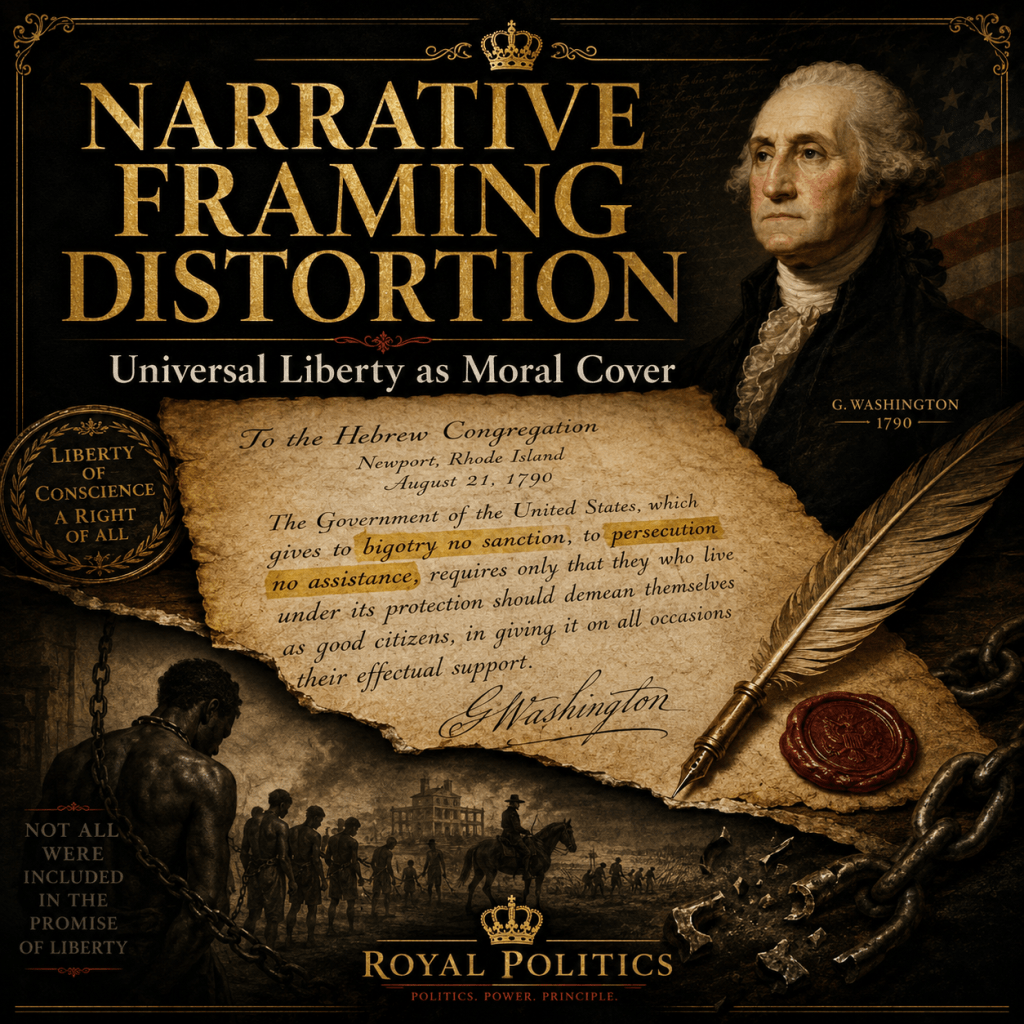
The 1790 exchange between Moses Seixas, speaking for the Hebrew Congregation in Newport, Rhode Island, and George Washington is not merely a beautiful religious-liberty story; it is a source-fidelity case study in narrative framing distortion. Seixas praised the new government as one “which to bigotry gives no sanction — to persecution no assistance,” while also describing “ALL liberty of conscience” and “immunities of citizenship”; Washington then repeated that frame back in his famous response, making the phrase one of the most celebrated statements of American tolerance. The problem is not the beauty of the words.
The problem is the gap between the words and the operating reality. In 1790, this universal liberty language was being exchanged between a recognized religious group and the president of a slaveholding republic, while Black people were still being held as property under the same government that claimed to give bigotry no sanction and persecution no assistance. That is the distortion: the frame says universal liberty, the institution practices selective liberty, and the moral language becomes cover for the violence underneath.
The Hebrew Congregation crafted the language of religious inclusion; Washington repeated it as national virtue; history later celebrates the exchange as proof of American tolerance, while the enslaved Black population is left outside the moral frame entirely. Source fidelity requires saying the quiet part clearly: a republic cannot claim universal liberty while protecting human bondage, and no polished language about conscience, citizenship, tolerance, or divine favor should be allowed to sanitize that contradiction.
Moses Seixas was not merely a symbolic religious outsider asking for protection. He was a leading Newport merchant, cofounder of the Bank of Rhode Island, and warden of an established synagogue community. That matters because the 1790 letter was not simply a plea from the margins; it was narrative framing from a positioned civic-commercial class. Seixas helped craft universal language about liberty, conscience, citizenship, bigotry, and persecution, and Washington repeated that language back as national virtue while slavery remained protected under the same republic. The distortion is clear: the frame sounded universal, but the freedom was selective. The language polished the institution while Black people remained outside the promise.
The invocation of God makes the distortion even sharper. Seixas’s letter did not merely use civic language; it placed liberty, conscience, citizenship, and divine favor inside the same moral frame. But Black people remained enslaved under the same republic. That means the problem was not only political hypocrisy. It was sacred moral cover: God-language used inside a society that still protected human bondage. Source fidelity requires saying this plainly: no appeal to divine liberty can cleanse a structure that denies liberty to the people it turns into property.
The optics become impossible to ignore when Moses Seixas is framed as a persecuted minority voice while also being described as a leading Newport merchant, synagogue warden, and cofounder of the Bank of Rhode Island. That is not a powerless social location. That is both incoherent moral and civic-financial positioning inside the early republic.
Civic-financial positioning is when someone holds public legitimacy and financial access at the same time, allowing them to shape narratives, institutions, and power from inside the system rather than from the margins.
Incoherent moral positioning is when power uses moral language selectively: persecution when challenged, virtue when praised, universal liberty when framing history, and selective liberty when protecting advantage.
The contradiction is not subtle: a bank cofounder and religious leader helped craft universal liberty language for Washington to echo while Black people remained enslaved under the same national order. Source fidelity requires asking why this history is so often framed as a clean tolerance story instead of a selective-liberty story. The words said bigotry, conscience, citizenship, and God. The structure said banking access for some and bondage for others.
Reparations require reality. America cannot repair what it refuses to name, cannot reconcile what it keeps reframing, and cannot move forward while using polished narratives to hide the source structure of slavery, exclusion, stolen labor, and inherited advantage. Black people are not waiting for another performance of sympathy. The long-overdue question is whether America is ready to stop pretending and enter source-fidelity truth.
Royal Politics examines power beyond the performance.
Book a strategy session with Royal Politics.
 Royal Politics
Leave a comment