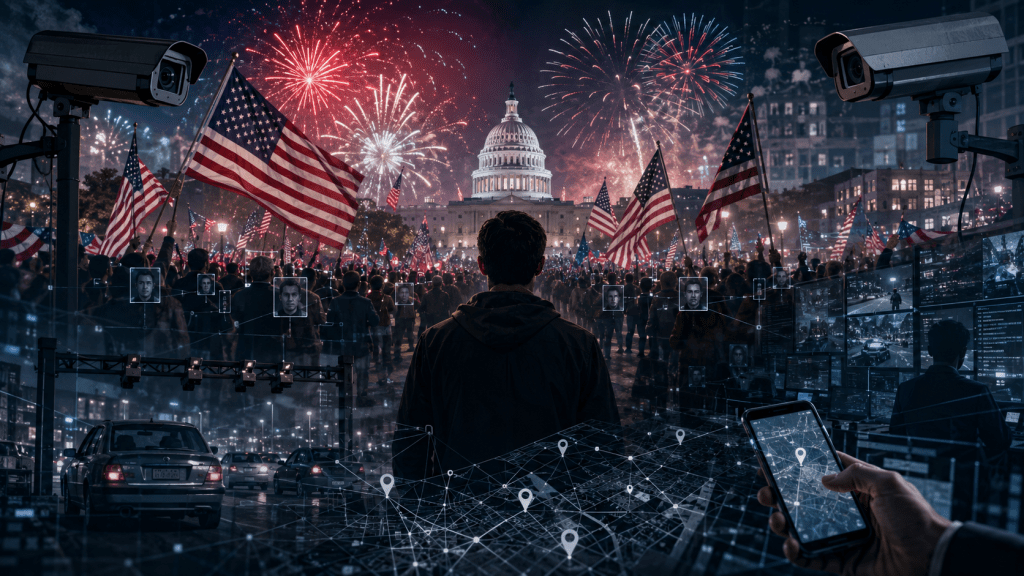
America knows how to perform pride.
The flags rise.
The fireworks go off.
The speeches return.
The songs play.
The word “freedom” is repeated until it feels like a national reflex.
But beneath the performance, a serious civic question remains:
Can a country truly celebrate freedom in public while normalizing surveillance in private?
That is not an anti-American question. That is an American question.
Because privacy is not anti-American. Privacy is one of the conditions that makes American freedom real.
A citizen cannot be fully free if they are constantly watched, tracked, profiled, scored, categorized, or quietly moved through invisible systems of suspicion. A person cannot meaningfully exercise speech, movement, creativity, protest, religious conscience, political thought, or private life if they believe every action may be absorbed into a government or law-enforcement data pipeline.
Freedom is not just the right to stand under a flag.
Freedom is the right to live without being treated like a suspect by default.
The Trust Problem
Public trust in government has not collapsed because people suddenly stopped caring about America. It has collapsed because many Americans no longer believe the government respects the boundary between public authority and private life.
Pew Research’s long-running data shows how severe the decline has become: public trust in the federal government has remained near historic lows for years, far below the high-trust levels of the mid-20th century.
That trust problem does not come from nowhere.
Americans remember the history.
They remember that the Church Committee investigated major intelligence abuses by federal agencies including the CIA, FBI, IRS, and NSA.
They remember MKULTRA, the CIA’s covert mind-control and behavioral research program.
They remember COINTELPRO, where federal power was used to surveil, disrupt, and discredit domestic political and civil-rights movements.
They remember that government misconduct is often denied, hidden, minimized, or justified until years later, when documents finally reveal what citizens were right to question.
So when modern officials say, “Trust us,” the public response is increasingly simple:
Why?
The Surveillance Stack
The modern surveillance state does not always look like a man in a trench coat following someone down the street.
Today, surveillance can look like a dashboard.
It can look like a camera network.
It can look like a license-plate reader.
It can look like a facial-recognition search.
It can look like a phone-location query.
It can look like social-media monitoring.
It can look like predictive policing.
It can look like artificial intelligence organizing scattered data into operational intelligence.
That is the deeper concern.
The issue is not one tool in isolation. The issue is fusion.
When cameras, phones, social platforms, license plates, public records, private vendors, data brokers, police systems, and AI analytics are combined, public life can become searchable. Movement becomes data. Speech becomes data. Association becomes data. Creativity becomes data. Ordinary behavior becomes intelligence.
At that point, the citizen is no longer simply living in society.
The citizen is moving through a surveillance stack.
Legal Protection Is Not the Same as Assurance
America does have privacy laws and constitutional protections. The Fourth Amendment is supposed to protect people from unreasonable searches and seizures. The Privacy Act of 1974 generally limits federal agencies from disclosing records about individuals without written consent, unless a statutory exception applies.
But that phrase — unless an exception applies — is where the public’s confidence begins to break.
Because once national security, law enforcement, emergency powers, classified programs, third-party vendors, data brokers, and AI systems enter the picture, the average citizen no longer knows where the real boundary is.
Section 702 of the Foreign Intelligence Surveillance Act shows the problem clearly. The program is officially aimed at foreigners outside the United States, but civil-liberties groups have long warned that Americans’ communications can be swept in and searched. Brennan Center resources describe Section 702 as a source of warrantless access to Americans’ communications, and Reuters reported in June 2026 that the law remained politically contested because of its privacy and intelligence implications.
That is the contradiction.
The government says the system is for security.
The citizen asks whether security has become a permanent excuse to weaken privacy.
Pride Without Privacy Becomes Performance
American pride should not require blind trust.
A healthy republic does not ask citizens to clap louder while the state becomes less transparent. A healthy republic does not celebrate liberty on stage while expanding monitoring behind the curtain.
If the government wants public trust, it must provide more than patriotic language. It must provide enforceable assurance.
That means clear warrants.
Clear limits.
Clear public reporting.
Independent audits.
Penalties for abuse.
Real remedies for citizens.
Restrictions on warrantless data-broker purchases.
Limits on AI fusion systems.
Disclosure after surveillance ends when safety allows.
Community consent before local surveillance systems are deployed.
And real accountability when public agencies cross the line.
Without those protections, freedom becomes branding.
Without privacy, citizenship becomes managed behavior.
Without accountability, surveillance becomes governance by invisible eyes.
Privacy Is Patriotic
Privacy is not a threat to America.
Privacy is part of what America claims to defend.
The right to think privately is freedom.
The right to speak without fear is freedom.
The right to move without being tracked by default is freedom.
The right to create without being profiled is freedom.
The right to dissent without being entered into a monitoring system is freedom.
The right to live as a citizen instead of a data point is freedom.
So the question is not whether Americans should be proud.
The question is whether the government is willing to behave in a way that deserves that pride.
Because a country cannot celebrate freedom in public while normalizing surveillance in private.
Privacy is not anti-American.
Privacy is one of the conditions that makes American freedom real.
Royal Politics examines power beyond the performance.
Book a strategy session with Royal Politics.
 Royal Politics
Leave a comment