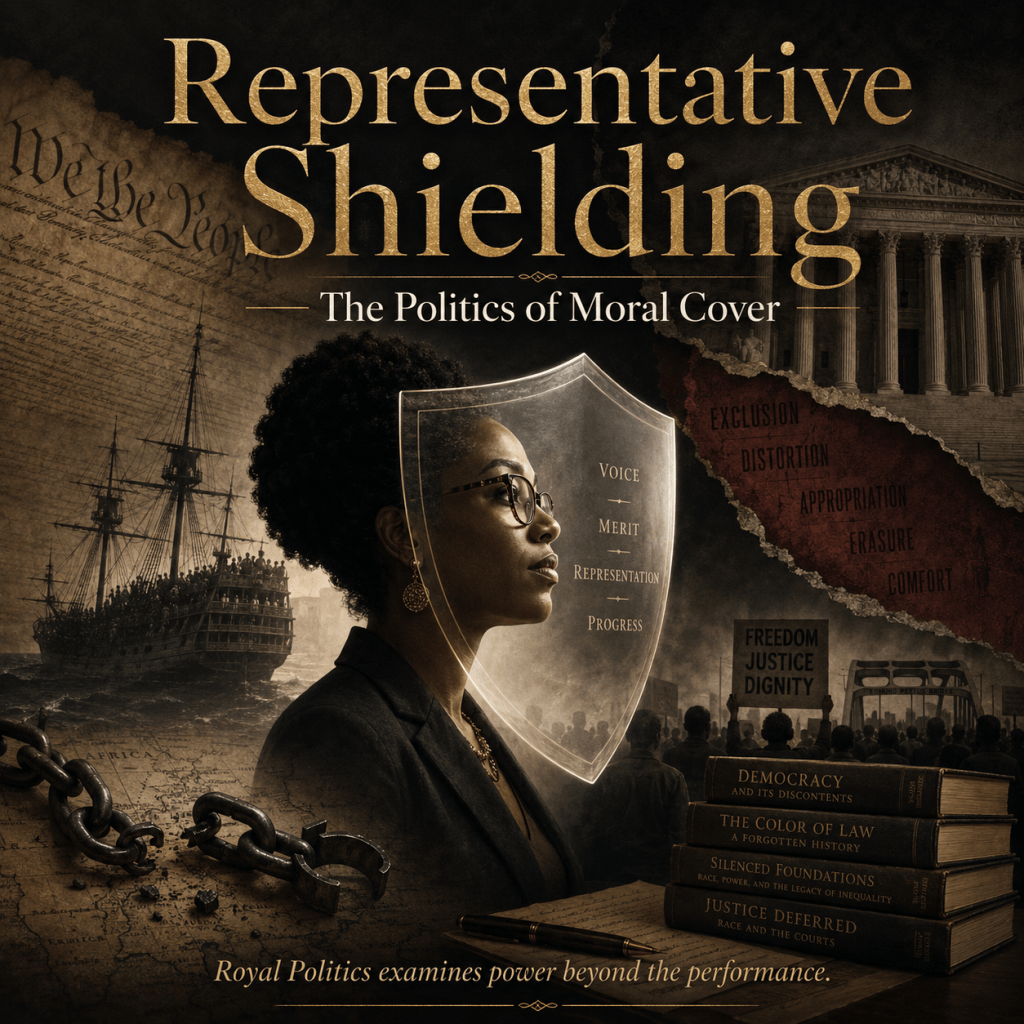
Representative shielding: a political distortion where a respected face from an impacted group is used to soften, sanitize, or redirect a narrative that protects an institution from source-fidelity review.
Sheryll Cashin’s America 250 opinion framing creates a source-fidelity problem because it appears to use abolitionism as a moral cover layer for a slavery ecosystem that should never have existed in the first place. Cashin is not an uninformed writer; she is the Carmack Waterhouse Professor of Law, Civil Rights and Social Justice at Georgetown University, teaches Constitutional Law and Race and American Law, has written books on segregation, white supremacy, interracial intimacy, integration failure, and racial inequality, and comes from a civil-rights family background. That makes the distortion more important, not less, because credentials can make a softened historical frame appear morally safe. The issue is not whether Black Americans must all share one view of America’s founding, and it is not whether resistance to slavery should be studied. The issue is that abolition does not redeem slavery, sanitize slavery, or balance slavery; it reveals that the slavery ecosystem was so morally corrupted that resistance became necessary. There would be no need to praise abolitionists as a national moral offset if slavery had never been built, legalized, financed, inherited, defended, and normalized in the first place.
The hypocrisy becomes even clearer when America’s founding stories are used to hide despicable realities under polished language, religious tolerance, abolitionist romance, or patriotic ideals. George Washington’s 1790 letter to the Hebrew Congregation in Newport, Rhode Island is often celebrated for its powerful language about religious liberty, including the promise that the United States would give “to bigotry no sanction, to persecution no assistance,” but Washington also lived inside and benefited from slavery; Mount Vernon states that at least 577 enslaved people lived and worked at Mount Vernon over his lifetime, with 317 enslaved people there by the end of his life. Thomas Jefferson presents the same distortion at an even deeper level: he wrote “all men are created equal,” yet Monticello states that he enslaved more than 610 human beings during his lifetime, and Monticello also states that he fathered at least six children with Sally Hemings, an enslaved woman at Monticello. That is the source-fidelity problem: freedom language cannot be allowed to wash bondage, religious tolerance cannot be allowed to wash human ownership, and abolitionist love stories cannot be used to soften the slavery ecosystem. The whole structure was wrong. Any narrative that asks the public to praise the beauty of the contradiction without fully condemning the system that created the contradiction is not clarity; it is moral cover.
The same distortion appears in the Federal Reserve debate. Lisa Cook is the first Black woman to serve as a Federal Reserve governor, and the Supreme Court’s recent ruling blocking President Trump’s attempt to remove her has been framed as a defense of central bank independence. Reuters reported that the Court ruled 5–4 against Trump’s attempt to fire Cook, reinforcing the Fed’s independence and preserving her position while the legal fight continued. But source-fidelity analysis has to separate the person from the structure. Cook’s historic status can be used to soften review of the Federal Reserve itself, turning criticism of a 1913 central banking power structure into a debate about representation, political attack, or institutional dignity. The issue is not whether Cook deserves due process, and it is not whether representation matters. The issue is whether her face becomes a shield for the Fed’s deeper distortions: interest-bearing monetary control, vague mandate language, legal insulation, market-first stability, difficult removal standards, and limited direct public correction. A Black woman at the front of the institution does not erase the structure behind the institution. The mask says representation. The ruling says independence. The public story says historic protection. The source-fidelity question asks whether the Federal Reserve is being protected from review by routing structural criticism through the image of a representative breakthrough.
This distortion is not new. Booker T. Washington’s Atlanta Compromise has long been remembered as an accommodationist frame that stressed economic progress while subordinating demands for political and equal rights. Ben Carson later softened slavery into an “immigrant” narrative by describing enslaved Africans as people who came in the bottoms of slave ships with dreams of future prosperity. Byron Donalds drew criticism for a Jim Crow nostalgia frame that emphasized Black family cohesion while critics argued it minimized the racial caste system surrounding it. Broader patriotic claims that America is “not a racist country” perform a similar function by asking the public to honor national ideals without fully confronting slavery, Jim Crow, redlining, segregation, exclusion, and racial violence. These examples show how representative voices can be used to soften, sanitize, or redirect the source truth when the full structure is too ugly for power to defend directly.
The same pattern appears in civil-rights institutional history when representative legitimacy becomes moral cover. The Southern Poverty Law Center was incorporated in 1971 by Morris Dees and Joseph Levin, with civil-rights leader Julian Bond named as its first president, giving the organization a powerful legitimacy layer around civil-rights litigation, public education, and later extremist tracking; yet recent federal allegations claim SPLC donor money was used to pay informants inside extremist organizations, which the SPLC denies while defending paid informants as intelligence and safety work.
The point is that moral identity can become operational cover when the public face softens the deeper structure. The mask says civil rights. The article says abolition. The institution says anti-hate. The source-fidelity question asks what structure is being protected underneath the story.
Royal Politics examines power beyond the performance.
Book a strategy session with Royal Politics.
 Royal Politics
Leave a comment