
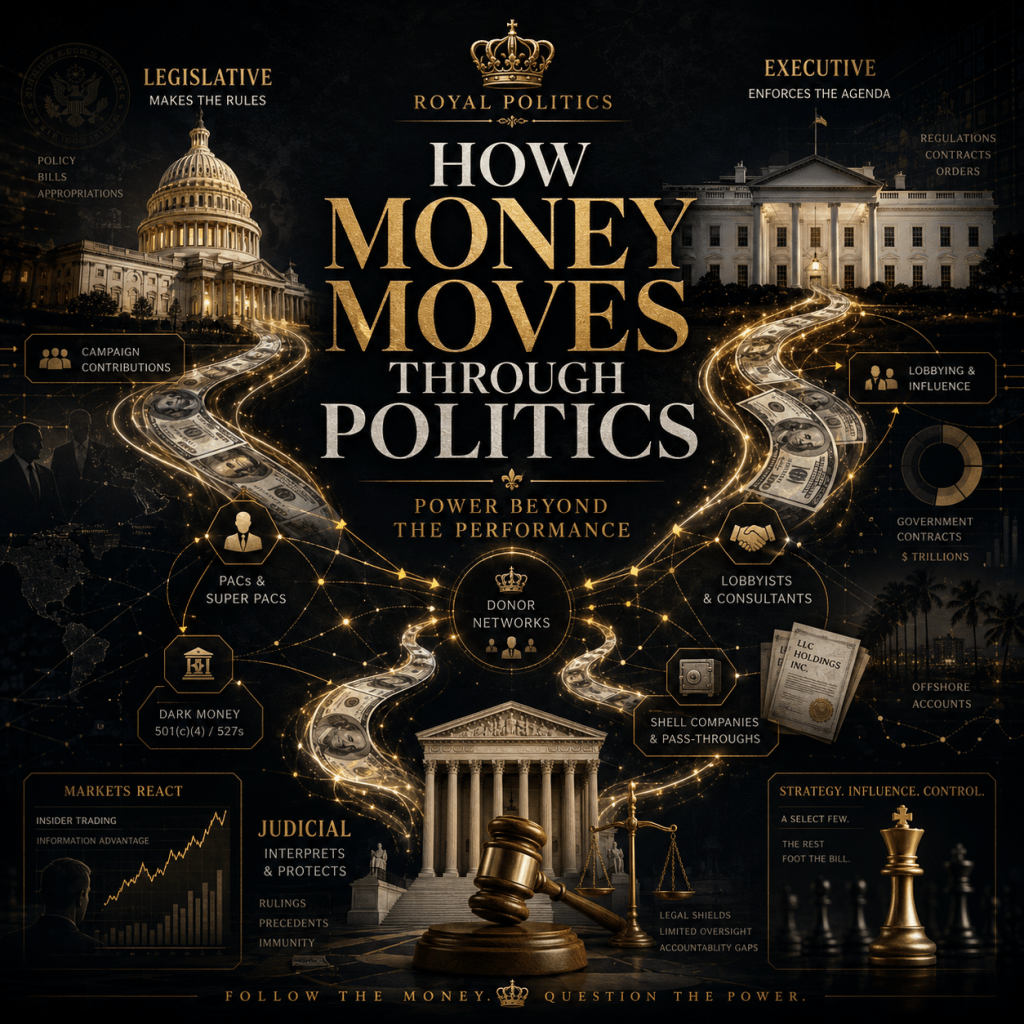
Money does not move through politics in one straight line; it moves through campaigns, parties, PACs, Super PACs, nonprofit networks, dark-money groups, shell companies, lobbyists, think tanks, media buys, donor events, consulting contracts, judicial pipelines, executive appointments, regulatory influence, insider access, stock trading, and the revolving door between public office and private power.
At the legislative level, money can shape who gets elected, what bills move, what language appears in legislation, and which industries receive protection.
At the executive level, money can flow through appointments, contractors, grants, procurement, regulatory capture, and policy access.
At the judicial level, influence may appear through legal advocacy networks, ideological funding, amicus briefs, judicial nomination pipelines, and long-term institutional pressure.
Outside the official structure, money moves through independent expenditures, party coordination, issue ads, nonprofits, donor-advised funds, shell entities, consulting vendors, data firms, and media operations that can shape public perception without always making the true source of power visible.
The FEC states that independent expenditures are not contributions and are not subject to limits, while campaign-finance watchdogs have warned that Super PACs and dark-money groups can spend heavily to influence elections, and the Brennan Center reported that dark money groups, nonprofits, and shell companies spent more than $1.9 billion in the 2024 federal cycle without fully revealing donors. The same problem extends into personal enrichment and insider access: the STOCK Act affirms that members of Congress and congressional employees are not exempt from insider-trading laws, yet critics note that disclosure rules and weak penalties still leave serious public-trust concerns around congressional stock trading.
The deeper issue is not only corruption in the obvious sense; it is that political money can operate as a hidden circulatory system, moving through legal channels, gray areas, influence networks, and institutional relationships until the public sees the performance but not the funding structure behind it.
Spotting the system is one thing, creating a strategy to address it is another.
Book a Strategy Session with Royal Politics
Need help turning a political issue into a strategy? Book a session with Royal Politics to discuss your goal, issue, campaign, or public-positioning need.
 Royal Politics
Leave a comment