
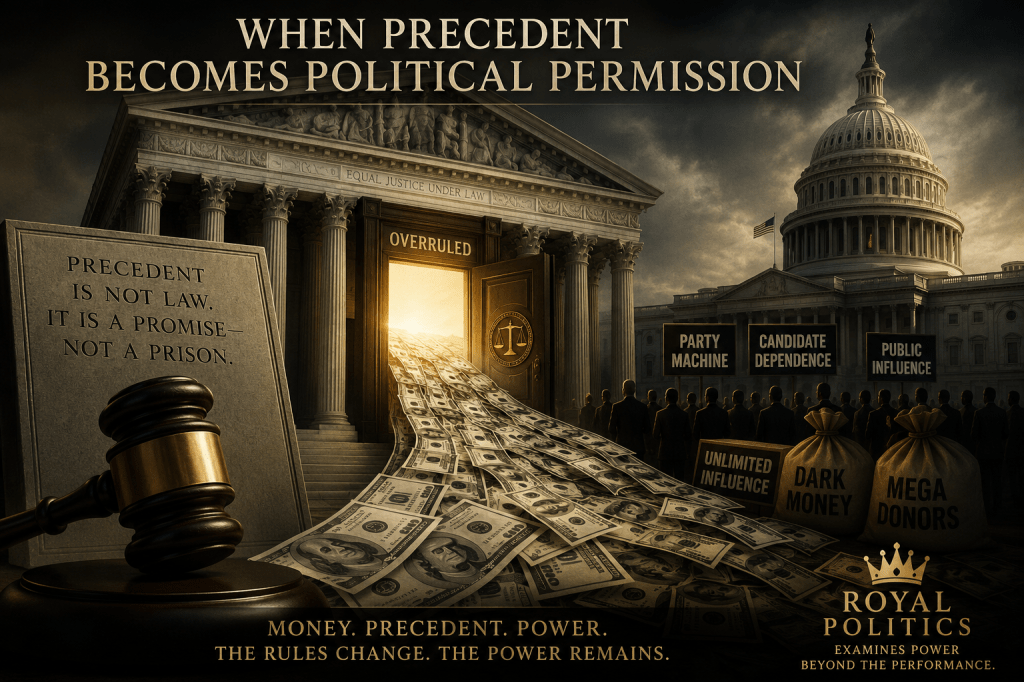
The Supreme Court’s recent ruling in National Republican Senatorial Committee v. FEC struck down federal limits on coordinated campaign spending between political parties and their candidates, ruling that those limits violated the First Amendment and overturning a 2001 precedent that had previously upheld them. The issue is not only campaign finance. The deeper problem is what happens when precedent becomes temporary permission instead of a stable governing anchor. Congress can pass campaign-finance rules, the Court can uphold them for years, political actors can organize around them, and then a later Court can reinterpret the Constitution in a way that shifts power again. This ruling does not make every form of campaign money unlimited, but it does remove limits on how much political parties can spend in coordination with federal candidates, giving donors and party machinery a larger pathway into campaigns. That matters because money, messaging, party control, candidate dependence, and public influence are not separate from governance; they shape who gets heard, who gets funded, who gets protected, and who gets ignored.
If the Court can repeatedly reinterpret the Constitution, overturn statutes, and discard precedent, then the Court becomes more than a referee. It becomes a governing actor.
The Court would say this is checks and balances working: Congress passed a law, someone challenged it, and the Court judged whether it violated constitutional free-speech protections. Critics would say this is the Court using constitutional interpretation to override Congress’s attempt to regulate political corruption and campaign influence.
The problem is not that the Supreme Court can review laws. The problem is that judicial review, unstable precedent, lifetime appointments, and political confirmation battles can allow the Court to reshape the rules of democracy while claiming it is only interpreting them.
That is above-the-theater politics. The public sees “law.” The deeper issue is institutional power deciding who gets to write, enforce, reinterpret, or erase the rules.
The Court treats some institutional arrangements as sacred stability and other institutional arrangements as disposable error.
With the Federal Reserve, the Court’s posture is basically: independence protects economic stability from political interference. In the Cook case, the Court blocked Trump from removing Lisa Cook for now, leaving the Fed’s independence intact while the case continues. Reporting also notes the decision left important questions unresolved about the exact standard for removing a Fed governor.
But with campaign-finance precedent, the Court’s posture is different: if a prior precedent conflicts with the current majority’s First Amendment view, it can be overruled. In National Republican Senatorial Committee v. FEC, the Court struck down limits on coordinated party-candidate spending and overturned a 2001 precedent that had upheld those limits.
So the deeper issue is not simply “independence versus precedent.” It is which forms of power the Court chooses to stabilize and which forms it chooses to destabilize.
The question is not whether the Supreme Court believes in independence or precedent. The question is which power centers receive protection, which rules are made disposable, and who benefits when the Court calls one structure stability and another structure unconstitutional.
Royal Politics examines power beyond the performance. Book a strategy session with Royal Politics.
 Royal Politics
Leave a comment