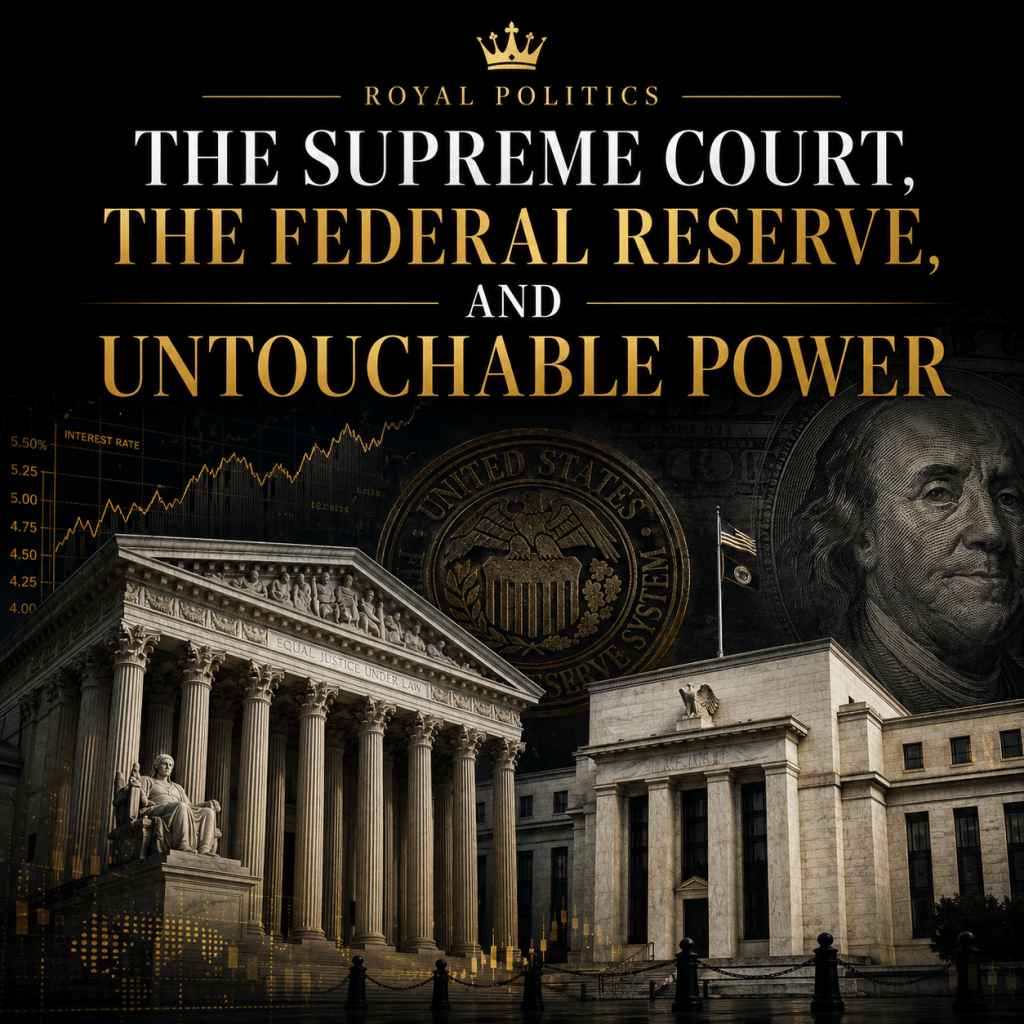
The Supreme Court’s recent ruling in the Lisa Cook case has been framed as a victory for Federal Reserve independence, but the deeper issue is whether the United States has allowed a 1913 central banking structure to become one of the most powerful and least directly accountable institutions in American governance. Congress created the Federal Reserve through the Federal Reserve Act, signed by President Woodrow Wilson in 1913, and gave it a broad mandate often described as maximum employment, stable prices, and moderate long-term interest rates; however, those terms are not fixed, self-defining, or mechanically enforced. Congress writes the mandate, the Federal Reserve interprets and executes it, the courts may protect its independence, and the public lives under the consequences through interest rates, inflation, credit conditions, mortgages, savings, employment pressure, and the cost of living. Federal Reserve governors also serve long terms and are difficult to remove, which may protect monetary policy from short-term political pressure, but protection can become insulation when power, vague standards, limited public control, and judicial protection combine. The Cook ruling is therefore bigger than one governor. It exposes a governance problem: independence is not the same as accountability. Royal Politics examines how institutional power operates when public authority, legal protection, economic control, and democratic accountability do not line up clearly.
Book a strategy session with Royal Politics.
 Royal Politics
Leave a comment